CIVIL SHIP REPAIR
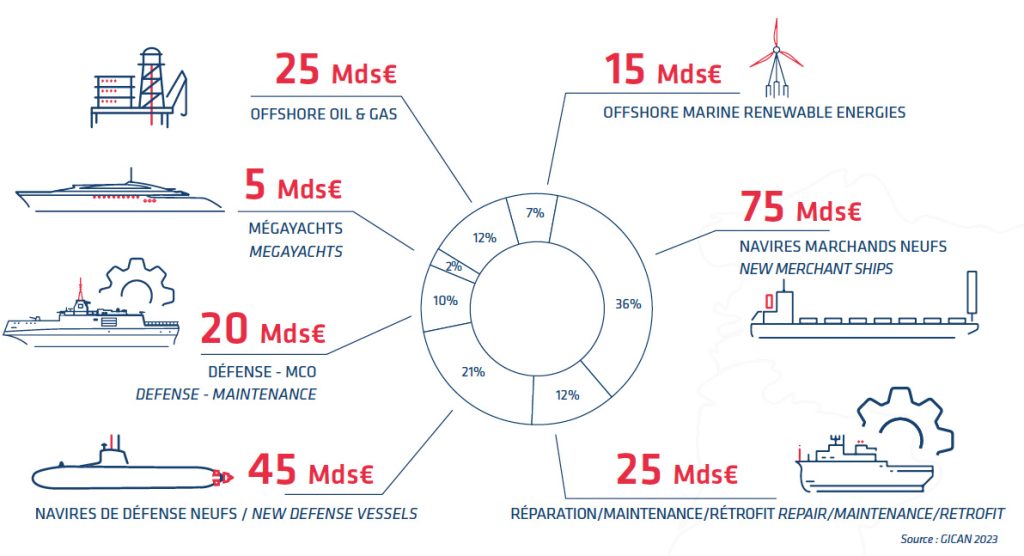
80% of goods transported worldwide are shipped by sea. Offshore activities, including the construction and the maintenance of wind farms, are growing exponentially.
Faced with this challenge, the French ship repair industry is organizing and developing itself to best meet the demands of this highly competitive industrial activity.
All shipyards, regardless of their size and the market segments they serve, are evolving and must adapt to improve their performance and flexibility.
Port dry docks are being brought into service thanks to investment, and the range of services on offer is increasing.
Equipment manufacturers remain key players for shipowners, but also for cooperating with shipyards to offer the best technical solutions to their customers.
Our industry is contributing to the energy transition by making significant changes to comply with constantly evolving standards and to protect the environment through internal actions that impact industrial processes.
Our primary challenge remains our ability to attract young people by offering rewarding training programs that enhance the appeal of our professions.
GICAN is working to ensure that ship repair is perceived as a promising career path and that trained employees are able to respond to demand with the highest level of qualification.
MAINTAINING OPERATIONAL READINESS
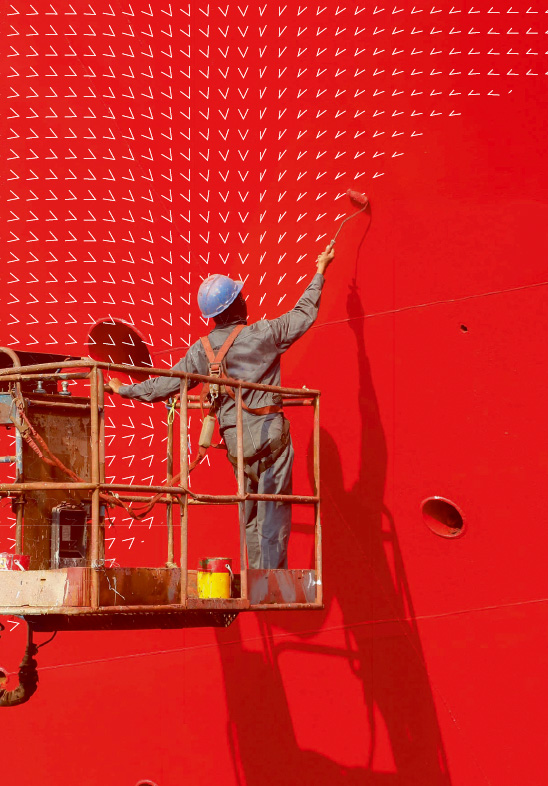
French Navy vessels are complex systems, whose operations are increasingly integrated, automated and digitized, often produced in small batches and requiring the maintenance skills of many different trades.
The Fleet Support Service (SSF) is responsible for ensuring the technical availability of naval forces by making the best possible use of resources allocated to it. It also ensures the decommissioning of ships withdrawn from active service.
Maintaining the operational readiness (MCO) of the naval sector requires heavy industrial and port infrastructure and resources. This is carried out in the two major ports of Toulon and Brest, as well as in Cherbourg and the overseas territories, and benefits ships deployed on operational missions far from their home ports all over the world.
The maintenance of nuclear-powered ships requires specific facilities.
Naval MCO includes maintenance services for ships and specific associated facilities, technical management services (equipment configuration management, MCO engineering, handling obsolescence and upgrades to ship facilities), the supply and storage of specific equipment (naval spare parts, nautical equipment, safety and diving equipment), expertise and repair services for specific equipment, ship decommissioning services and associated waste disposal or recovery operations.
In addition to standard maintenance for ships in terms of the hull, propulsion and all utilities, warships are equipped with specific weapons systems and equipment (communication, detection, countermeasures). The MCO of nuclear submarines and aircraft carriers is the most complex and strategic part of the SSF’s missions.
For each class of vessel, the SSF entrusts the overall project management of MCO to private industrial fabric throughout the country, both in mainland France and overseas.
While some maintenance operations are carried out by state entities, the SSF enters contracts with numerous private partners. These vary in scope and scale, ranging from overall project management for the maintenance of largest buildings to cross-functional, sometimes specialized services. As a result of these contracts, a myriad of companies is mobilized in France’s major naval basins, including overseas territories: the budgets allocated to naval MCO thus feed into the entire local industrial fabric in Toulon, Brest, Cherbourg and overseas territories.
Industrial companies holding SSF contracts benefit from excellent visibility on their workload thanks to multi-year contracts and long maintenance schedules of around seven years. This allows the SSF to benefit grom continuity in the services provided and enables industrial players to plan and invest over the long term.
As such, naval maintenance activities contribute significantly to the economic trickle-down effect from major industrial players to SMEs and mid-cap companies, helping to nourish the industrial and technological fabric.
With nearly a quarter of a century of experience in MCO, the SSF has a wealth of expertise and continues to strive for improvement. However, in a volatile international context and a constantly evolving technological environment, the SSF is committed to anticipating and preparing for high-intensity crisis situations.
By constantly monitoring innovations that can be exploited in naval MCO, the SSF seeks to test and then implement innovations that can be directly exploited for its MCO activities. To scope covered is vast: the use of drones for inspections of confined, submerged or high-altitude areas, 3d printing, remote maintenance and remote assistance between land and deployed units, computerization of repetitive tasks with RPA (Robotic Process Automation), etc. Ultimately, the idea is to increase MCO performance by going faster, further and reducing the environmental footprint of activities as much as possible.
The unstable, uncertain and dangerous international context exposes MCO activities to numerous risks. The health crisis has put organizations to the test and reignited the question of resilience. The exacerbation of power relations, which is part of the global rearmament context requires the MCO to prepare for a major engagement. To this end, the SSF has launched the Tangaroa project, the name given to the preparation of highly-intensity naval MCO activities in close collaboration with a panel of companies from the naval MCO’s BITD.