Delair and Cerbair Join Forces in the Fight Against Drones
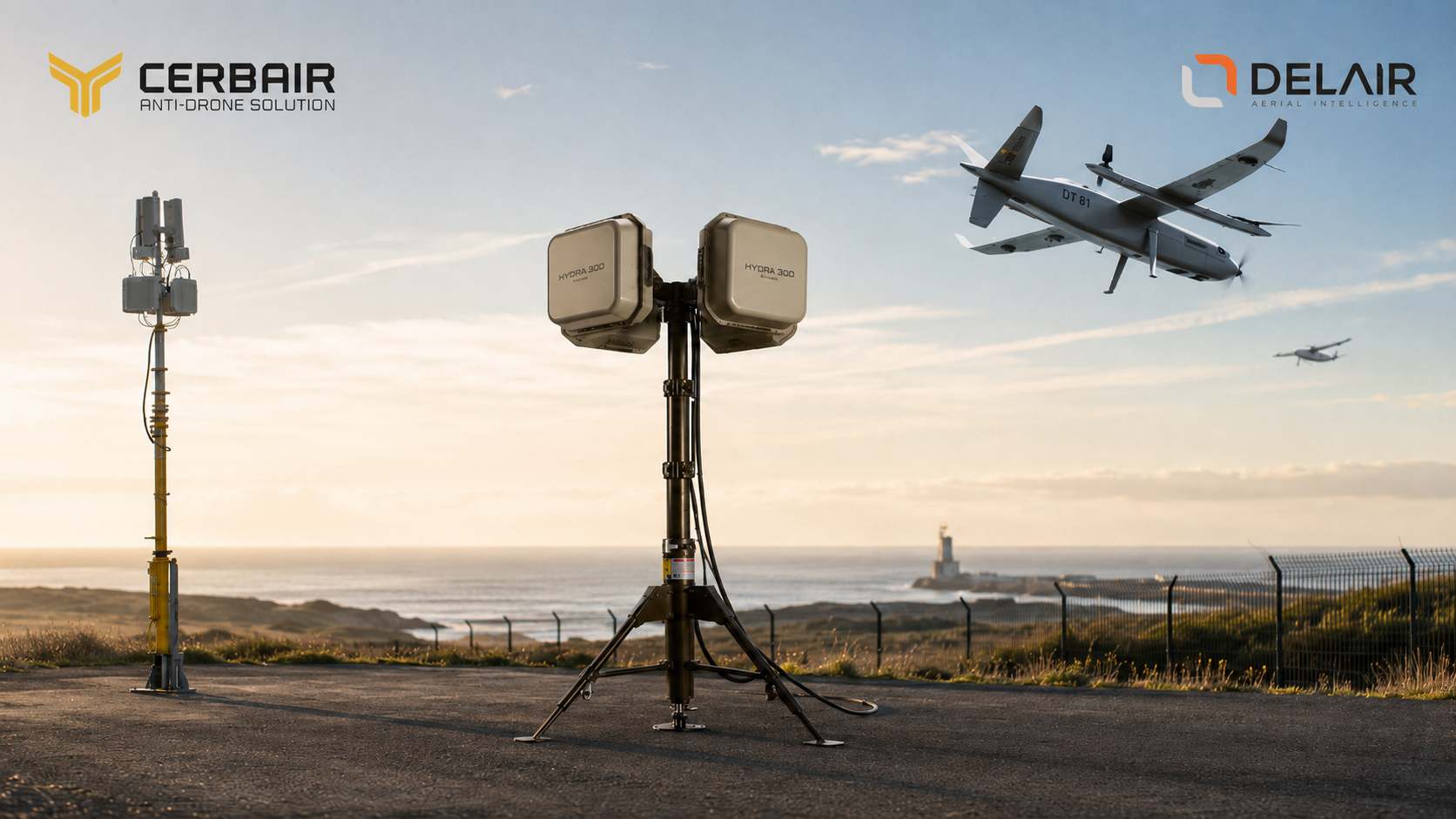
Delair and Cerbair have announced a long-term strategic partnership to address the rapidly evolving landscape of aerial threats. The aim is to combine two complementary areas of French expertise in order to develop a new-generation, sovereign solution for counter-drone operations, as well as for airborne electronic warfare applications.
Cerbair, a French specialist in the detection, identification, localisation and neutralisation of drones, will contribute its expertise in so-called ‘low-altitude’ threats – those that operate at low altitudes and remain difficult to detect. Delair will contribute its defence drone platforms, notably its Aspik interceptor, designed to provide a rapid and tailored response to emerging threats.
The two companies aim to develop a joint roadmap combining R&D, operational integration, innovation and the expansion into international markets. Their ambition is to offer the armed forces, critical infrastructure operators and security stakeholders a comprehensive solution, from detection through to neutralisation.
A response to a threat that has taken centre stage
Counter-drone measures have become one of the major security challenges. Recent conflicts have shown that a modified commercial drone, a remotely operated munition or a swarm of small aircraft can have a major tactical impact at a relatively low cost. This asymmetry is shifting the balance of power: it is unsustainable to deploy highly expensive defence systems against drones that are sometimes manufactured for just a few hundred or a few thousand euros.
Hence the need for a multi-layered defence. An effective response must combine early detection, drone identification, tracking of its transmissions or pilot, electronic jamming and, where necessary, physical interception. Electronic warfare plays a central role here, as many drones rely on radio signals, data links or navigation systems that can be detected, disrupted or deceived.
This issue is particularly sensitive in the naval sphere. At sea, a military vessel or port infrastructure represents a high-value target, often exposed in an open space where a very rapid response is required. Drones can observe, designate a target, overwhelm a defence system or carry out a direct attack. They therefore compel navies to protect ships, naval bases, port approaches, convoys and amphibious operations. In this environment, the early detection of a low-altitude threat and the selection of a proportionate response become a matter of operational survival.
This is what makes the collaboration between Delair and Cerbair strategic. By combining expertise in drone technology with that of counter-drone operations, the two companies can develop solutions that are more realistic, more integrated and better suited to the needs of the armed forces. In particular, they plan to explore the integration of airborne electronic warfare capabilities onto Delair aerial platforms. The drone could thus become not only a sensor, but also a tool for electromagnetic intelligence, jamming or support for neutralisation.
Lucas Le Bell, chairman of Cerbair, sums up the issue by emphasising that “mastering drones and the technologies needed to defend against them is an absolute priority for our armed forces”. Bastien Mancini, president of Delair, for his part, emphasises “an absolute necessity”: enabling French defence manufacturers to collectively devise “comprehensive, innovative and sovereign” solutions.
Fostering French champions in the defence industrial and technological base
This partnership illustrates the industrial role played by innovative SMEs and mid-cap companies, such as Cerbair and Delair, in fostering French champions within the defence industrial and technological base capable of competing on a global scale.
Cerbair claims to have solutions deployed in 30 countries across four continents, serving armed forces, law enforcement agencies, prison facilities and critical infrastructure operators. Delair states that it has several thousand drones in operation in more than 75 countries, with an industrial presence in France and growth driven by professional, security and defence applications.
To transform these successes into global leadership, cooperation is essential. No single company can, on its own, address the full complexity of the drone threat: sensors, signal processing, artificial intelligence, electronic warfare, aerial platforms, interceptors and system integration. By developing joint offerings, French SMEs and mid-cap companies gain credibility, gain access to new markets and offer military customers more comprehensive solutions.
This approach is crucial to sovereignty. In a field where reliance on foreign sources can become a vulnerability, having national players capable of designing, producing and improving their own systems is a strategic asset. The challenge is not merely to sell equipment, but to retain control over the critical components that will protect French, European and allied forces in the future.
Recent Articles